



Even though the activity has come to an end, luxury establishments are popping up across the country, without any government oversight, tax collection or creation of formal jobs.
Eighty years ago, on 30 April 1946, President Eurico Gaspar Dutra dealt a harsh blow to Brazilian society by ordering the closure of casinos through a decree. Based on religious principles, the measure brought an end to an era of glamour. This drove the industry underground, and to this day, the ban prevents the country from collecting billions of Brazilian reais in taxes.
End of casinos in Brazil
Casinos in Brazil were closed by Decree-Law No. 9215, issued by President Dutra. It is said that the president was influenced by his wife, Dona Carmela (known as Dona Santinha, which means Mrs Holy), an extremely religious woman who was against gambling.
Dutra was also influenced by the then-minister of justice, Carlos Luz, who aspired to be governor of Minas Gerais and fought against casinos in the name of the “traditional Minas Gerais family.” He shut down the casinos … but lost the election.
It wasn’t just religious reasons that led Dutra to close the casinos. Political action prevailed, and it marked the end of an era in the fight against Getúlio Vargas. In addition to being a regular at casinos, it was said that he profited financially from the activity. Furthermore, casinos in Rio de Janeiro were allegedly owned by his brother Benjamim Vargas, who used a former muleteer, Joaquim Rolla, as his front man.
Reasons
The decree-law that shut down the casinos cited the following reasons for the presidential decision:
“Whereas repression of gambling is an imperative of universal consciousness;
“Whereas the criminal laws of all civilised nations contain provisions designed to achieve this end;
“Whereas the legal, moral and religious traditions of the Brazilian people are opposed to the practice and operation of gambling.”
On that fateful day for the industry, the president met with his ministers, secretaries of state and the head of the Federal Department of Public Safety to discuss two sensitive issues: the closure of casinos and the fight against communism. He decided to shut down the casinos and put off the hunt for communists for later. Ironically, both went underground and suffered years on end. Fortunately, the communists have earned their place in the sun … but the casinos haven’t yet.
The impact of the casino closures was immediate, and most of the newspapers published that afternoon with headlines about the end of the casinos sold out quickly. The newspaper Resistência (Resistance) stands out.
On 5 May, they released an article defending the thousands of jobs at stake: “A Severe Blow to the Country’s Artistic Future!: In line with its guidelines, Resistência has launched a campaign to support the demands of all those who, as a result of the decree-law that abolished gambling, found themselves facing unexpected disruption to their work.”
As can be seen, even in the 1940s, the sector’s role in job creation was substantial, and social concern for the unemployed was reflected in the press, albeit in a very tentative manner, since Brazil – having only recently emerged from Getúlio Vargas’s Estado Novo dictatorship – had not yet achieved freedom of the press, and some of the most important newspapers of the time supported the Dutra administration.
Eighty years later, the employment crisis persists in the country and Brazil is still missing out on the hundreds of thousands of jobs that the gaming industry could create.
Black 31
“Ladies and gentlemen, place your bets for the final spin of the roulette wheel in Brazil!”
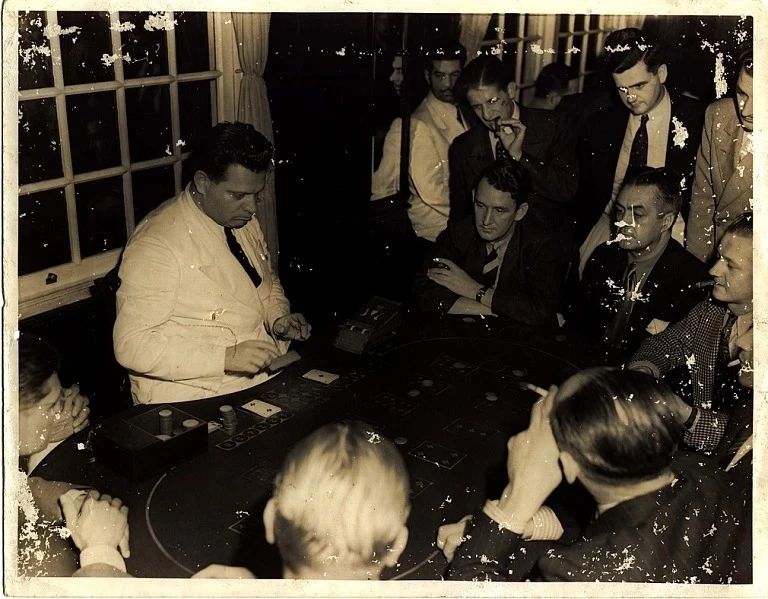
At 11pm on 30 April 1946, in a solemn tone, struggling to hold back the tears welling up in his eyes, José Caribé da Rocha, director of the Copacabana Palace Casino in Rio de Janeiro, announced the final game of roulette in Brazilian casinos, ending an era of glamour, stories and luxury. After the announcement, his suppressed tears welled up, his face reflecting the same emotion felt by thousands of patrons and more than 40,000 workers at the roughly 70 casinos that existed in Brazil at the time.
A few minutes later, BLACK 31…

Overnight
Casinos first appeared in Brazil during the Empire, but were forced underground in 1917, during the Republic Period. In 1934, President Vargas legalised gambling in Brazil and was even a regular at many casinos across the country.
When they reemerged in 1934 and throughout the 12 years they were in operation, they spread across several states. It was during this period that spectacular shows – in addition to the games themselves – took centre stage at the major casinos, featuring many artists from Brazil and abroad.
But shutting down an activity that had previously been authorised by the government and the way it was done was not merely disrespectful, it was extremely heavy-handed. Instead of setting a deadline for the closure of casinos, the decree-law took effect on the date of its publication, catching business owners, employees and performers who had performance contracts with the casinos off guard.
One could even call it a betrayal by the government, since during the election campaign, Dutra’s opponent, Brigadier Eduardo Gomes, had strongly advocated for the closure of casinos. Because of this stance, several business leaders in the sector endorsed Dutra’s candidacy. He took office in January and, three months later, he dealt the final blow to the operation. Another example of the impact that such a measure caused was the Lambari Casino in Minas Gerais, inaugurated one day before the activity ban. Did anyone compensate investors?